What Is Homeschooling? Is It Right for Your Child?
Child-led home education guide for parents: styles, routines, pros, cons, how to start, and a checklist.
Ayni Ali
1/2/20267 min read


If you are searching “what is homeschooling,” you are probably holding a mix of hope and worry in the
same hand.l Will my child really learn at home?l Do I have to follow a strict school-style timetable?l Can I protect curiosity instead of turning home into another classroom?You are not alone. More families are exploring home education because they want flexibility, calmer
routines, and learning that fits a child, not the other way around.
Quick answer: Homeschooling (home education) means the family takes primary responsibility for learning. It can be structured like school, interest-led and child-led, or a blend of both. The right fit depends on your child’s needs, your support system, and your local rules.
1) What is homeschooling? A simple definition (and what it is not)
Homeschooling (also called home education) means parents or guardians take primary responsibility for a child’s learning instead of sending them full-time to a conventional school.
At home
In libraries, parks, museums, and community spaces
Online (live classes or recorded lessons)
With tutors, relatives, and learning groups
Homeschooling is not only “school at the kitchen table.” Some families do follow a timetable and textbooks. Many do not. Real homeschooling is not the same as emergency online school, because the family chooses the approach, the pace, and the resources.
A note about legal requirements: rules vary widely by country and sometimes by region. Before you change anything officially, check your local requirements for registration, records, and exam pathways.
2) Homeschooling styles: from school-at-home to child-led learning
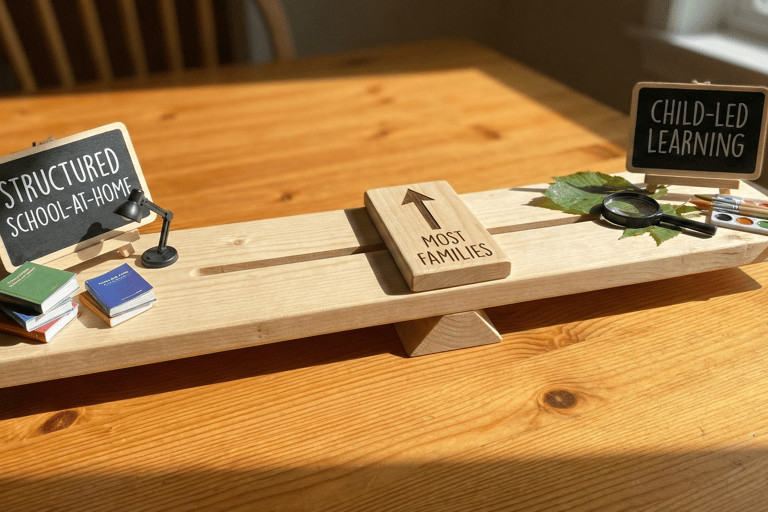
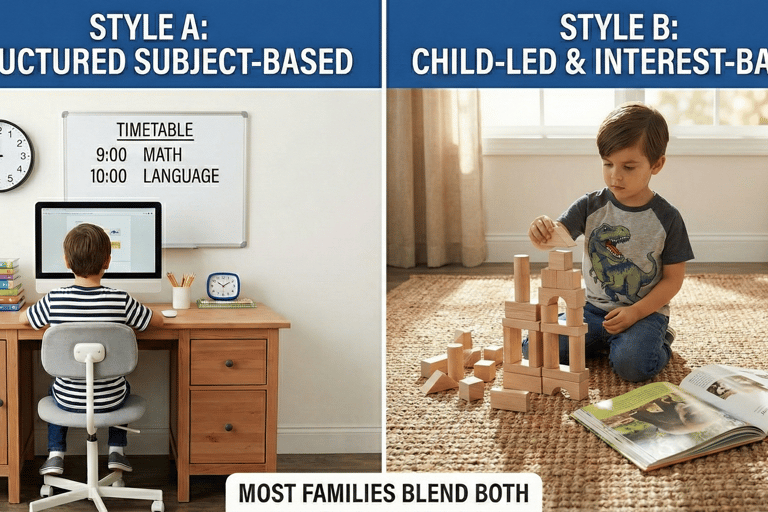
One reason homeschooling is hard to define in one sentence is that it comes in many styles. Imagine a sliding scale: structured school-at-home on one end, and child-led learning on the other. Most families sit somewhere in the middle.
Style A: Subject-based (structured) homeschooling
This looks closer to traditional school, just smaller and more personal. For example:l Maths at 9:00, language at 10:00l Science after a breakl A set number of tasks each dayThis can work well if:l You are new and want clear structurel Your child is preparing for formal examsl Your family needs predictable blocks because of work hoursThe risk: if you copy school too closely, you may recreate the same pressure that made you consider homeschooling in the first place.
Style B: Child-led and interest-led homeschooling (aptitude-based)
Child-led homeschooling starts with a child’s interests and strengths, then builds skills and knowledge around them. Core skills like reading, writing, and numeracy still matter, but they are taught in flexible, connected ways.
Examples:
A child who loves animals learns reading through animal stories, science through habitats, and maths by planning food and space.
A child who loves space follows missions, builds models, reads biographies, and uses maths for distance and time.
A child who loves building learns measurement and problem-solving through LEGO, crafts, and simple projects.
Important: child-led does not mean child abandoned. You still guide. You notice patterns, offer books and tools, introduce new experiences, and gently add missing skills at the right time.
Most families blend both styles: a simple structure for core skills, plus a protected daily block for curiosity, projects, and real-world learning.
3) What does a homeschool day look like? A flexible routine that still feels calm
There is no single right schedule. But many families find peace in a simple rhythm. Here is an example for ages 8 to 10:
Morning rhythm (15 to 30 minutes)
Breakfast
A short read-aloud
A quick plan: “What is one thing you want to learn today?
Core skills block (60 to 90 minutes)
A maths program or workbook
Reading aloud plus independent reading
Writing in small doses: a journal, a letter, a short response.
Break and movement
Snackl Outdoor time
A walk, stretching, play
Curiosity project block (45 to 60 minutes)
This is where child-led learning shines:
A simple experiment connected to a question
A geography project about a country your child loves
Art, building, coding, cooking, design
Lunch and quiet reset
Readingl Drawing
RestAfternoon life learning
Chores and practical life skills
Sports, clubs, co-ops
Creating a Homeschool Schedule
When considering homeschooling, many parents grapple with the concept of scheduling. A common misconception is that homeschooling necessitates a rigid timetable similar to traditional school systems. However, creating an effective homeschool schedule is more about establishing a structure that supports learning while allowing for flexibility and creativity.
One of the fundamental advantages of homeschooling is the capacity to tailor a daily and weekly plan to suit your child’s unique learning style and pace. Rather than adhering to a strict timetable, families can benefit from a more fluid approach. This could mean setting aside specific blocks of time for subjects while allowing spontaneous learning opportunities to arise. For example, a child who shows a keen interest in science may benefit from extended exploration on a given day, while another day could focus more intensely on math. This individualized approach can foster a love for learning and accommodate your child's natural rhythms and interests.
To create an effective weekly plan, start by identifying core subjects and required educational goals. Breaking down subjects into manageable segments helps maintain focus without overwhelming your child. Incorporating breaks, as well as outdoor activities and practical experiences, can enrich the learning process. Additionally, it is essential to allow for adjustments in your schedule. If a lesson does not resonate or if a child is speedily mastering a topic, it is perfectly acceptable to adapt your plans accordingly. Keeping track of progress through informal assessments can guide these adjustments, ensuring that the schedule remains dynamic and responsive.
In conclusion, creating a homeschool schedule does not require adhering to rigidity but rather encourages flexibility and routine in a supportive learning environment. By focusing on both structure and spontaneity, parents can facilitate a productive and enjoyable homeschooling experience.
Keeping Curiosity Alive
In a homeschooling environment, fostering a child’s natural curiosity is essential for promoting a love of learning. This can be achieved through various experiential learning opportunities that engage students in active exploration. One effective approach is to emphasize hands-on activities that allow children to discover concepts through firsthand experience. This could include science experiments, nature walks, or even cooking projects that integrate math and chemistry.
Another way to maintain curiosity is by incorporating children's interests into the curriculum. By allowing students to choose topics that genuinely excite them, parents can create a more engaging and personalized learning experience. For instance, if a child is fascinated by dinosaurs, a homeschooling curriculum can include reading books about paleontology, visiting natural history museums, or creating art projects related to this subject. Such thematic learning helps students make connections between their interests and various academic disciplines.
Outdoor activities can also play a vital role in encouraging curiosity. Nature exploration is a powerful tool for inspiring wonder and inquiry. Activities such as gardening, bird watching, or hiking enable children to observe and interact with their environment, prompting them to ask questions and seek answers. Additionally, integrating technology into lessons can further excite learners—consider using educational apps or online resources that align with a child's interests. By providing varied and flexible learning experiences, homeschooling can nurture a lifelong passion for knowledge.
Ultimately, keeping curiosity alive in a homeschool setting involves creating a dynamic learning environment that values exploration and personal interests. When students are encouraged to follow their natural inclinations, they develop a more profound and enduring love for learning, which is the foundation of successful homeschooling.
Support and Resources for Homeschooling
Homeschooling has gained significant traction in recent years, fueled by an increasing number of families opting to take control of their children's education. Successful homeschooling often hinges on leveraging the right support and resources. An abundance of online courses is available, catering to various age groups and subjects, allowing parents and students the flexibility to design their own curriculum. Websites like Khan Academy, Coursera, and Udemy offer a wealth of educational content that can be utilized to supplement traditional teaching methods.
In addition to online materials, community groups play a pivotal role in providing support for homeschooling families. These groups can be local or virtual and often serve as valuable platforms for networking, sharing experiences, and exchanging resources. Joining a homeschooling co-op can also provide collaborative learning opportunities, where families come together to teach subjects or organize group activities, enriching the educational experience.
Moreover, finding reliable curriculum resources is essential to establishing a coherent educational path. Many homeschooling families turn to established publishers that specialize in educational materials tailored to home education. Resources such as the Homeschool Legal Defense Association (HSLDA) offer valuable insights into legal requirements and provide a directory of curriculum providers. Parents are encouraged to explore multiple sources and consult reviews to determine the best fit for their children's learning styles.
Additionally, connecting with other homeschooling families can provide not only motivation but also practical advice and solutions to common challenges. Social networks and forums dedicated to homeschooling are great platforms for discussion and resource sharing. By tapping into these networks, homeschooling parents can create a supportive environment that fosters not only academic growth but also social development for their children.
Making the Decision: To Homeschool or Not?
Deciding whether to homeschool is a significant choice for any family. Parents contemplating this educational path should first reflect on their motivations and the fundamental reasons for considering homeschooling. It is essential to examine personal philosophies and overarching educational goals before making this commitment.
If you are searching “what is homeschooling,” you are probably holding a mix of hope and worry in the
same hand.l Will my child really learn at home?l Do I have to follow a strict school-style timetable?l Can I protect curiosity instead of turning home into another classroom?You are not alone. More families are exploring home education because they want flexibility, calmer
routines, and learning that fits a child, not the other way around.
Quick answer: Homeschooling (home education) means the family takes primary responsibility
for learning. It can be structured like school, interest-led and child-led, or a blend of both. The right
fit depends on your child’s needs, your support system, and your local rules.